

When it comes to injectables, one truth stands out: an understanding of facial anatomy is the foundation of safe and beautiful results. Whether you’re performing a dermal filler injection, Botox treatment, or advanced facial rejuvenation, every injector must know the facial muscles, arteries and veins, fat pads, and landmarks that define the art and science of aesthetics.
In this article, we’ll break down facial anatomy step by step:
Let’s explore how to inject fillers safely while managing complications and enhancing facial features with precision.

Why Facial Anatomy Matters for Aesthetic Injectors
If you’re practicing in the field of aesthetic medicine, understanding facial anatomy isn’t optional—it’s essential. Safe, precise, and natural-looking results depend on knowing where the vessels and nerves lie, how the facial artery branches, and how facial structures change with age. Studies show that complications such as intravascular injection can lead to devastating outcomes, including skin necrosis and even blindness, if injectors aren’t mindful of neurovascular pathways and filler injection techniques.
Without anatomical knowledge, injectors risk:
- Superficial injection into high-risk areas like the glabellar region or nasolabial folds where angular arteries and infraorbital vessels are present.
- Using a needle or cannula without accounting for ligament support, facial fat compartments, or the superficial musculoaponeurotic system (SMAS).
- Misjudging the volumes of filler in delicate areas like the orbital region, zygomatic arch, or jawline.
By contrast, mastering anatomical landmarks helps injectors:
- Deliver aesthetic facial rejuvenation that enhances features like the lips (guided by the superior and inferior labial arteries and the depressor anguli oris).
- Confidently place hyaluronic acid fillers for facial volumization while protecting the superficial temporal artery and supraorbital/supratrochlear vessels.
- Use botulinum toxin strategically in the platysma, orbicularis oris, and masseter to refine balance and symmetry.
For every aesthetic clinician, whether in dermatology, plastic surgery, or facial cosmetic practice, a deep understanding of different facial layers, vessels, and nerves is what separates safe, predictable results from serious complications.
Why is facial anatomy for injectors important?
It ensures safe injections, prevents complications, and helps achieve natural results.
Facial Anatomy Aesthetics – Shaping Natural Beauty
In aesthetic medicine, the placement of an injectable is just as important as the product itself. A well-placed filler can restore youthful volume, while poor placement can distort natural facial structures. Research shows that changes in superficial and deep fat pads are key drivers of facial aging. This means injectors must understand not just “where” but also “how deep” to place filler for safe, natural results.
Balancing Proportions with Knowledge of Anatomy
Every face tells a unique story, and maintaining facial balance is central to that story. By respecting anatomical landmarks like the zygoma, jawline, and nasolabial folds, injectors can achieve harmony instead of overcorrection. Balance is achieved by:
- Restoring midface volume to support the lower face
- Using small, precise filler amounts to keep proportions natural
- Avoiding overfilling areas that can throw off facial harmony
Tailoring Treatments to Each Face
There’s no one-size-fits-all in the field of aesthetic treatments. Each patient’s facial anatomy requires a customized plan. For example:
- A patient with hollow temples may benefit from subtle lateral volumization.
- Someone with heavy nasolabial folds might see better results from midface support rather than direct fold injections.
- Patients with asymmetric features require careful adjustments to restore balance without overcorrecting.
By tailoring treatments, aesthetic clinicians can create results that feel authentic, enhance natural beauty, and minimize risks of complications.
What are high-risk areas for dermal filler injections?
The glabella, nasolabial folds, and infraorbital region are most at risk due to the presence of major vessels.
Facial Anatomy for Dermal Fillers – What You Need to Know
When working with injectables, every dermatologist or facial plastic practitioner must understand the superficial and deep layers of the face. These include the skin, facial fat compartments that change with facial aging, underlying muscles, and the vasculature. For example, the supraorbital and supratrochlear vessels emerge through the foramen of the upper face, making them critical structures to identify during treatment.
High-Risk Areas to Watch Out For
Certain regions are particularly prone to complications, especially when fillers inadvertently enter the two main vessels of the face: the facial artery and the ophthalmic artery. High-risk areas include:
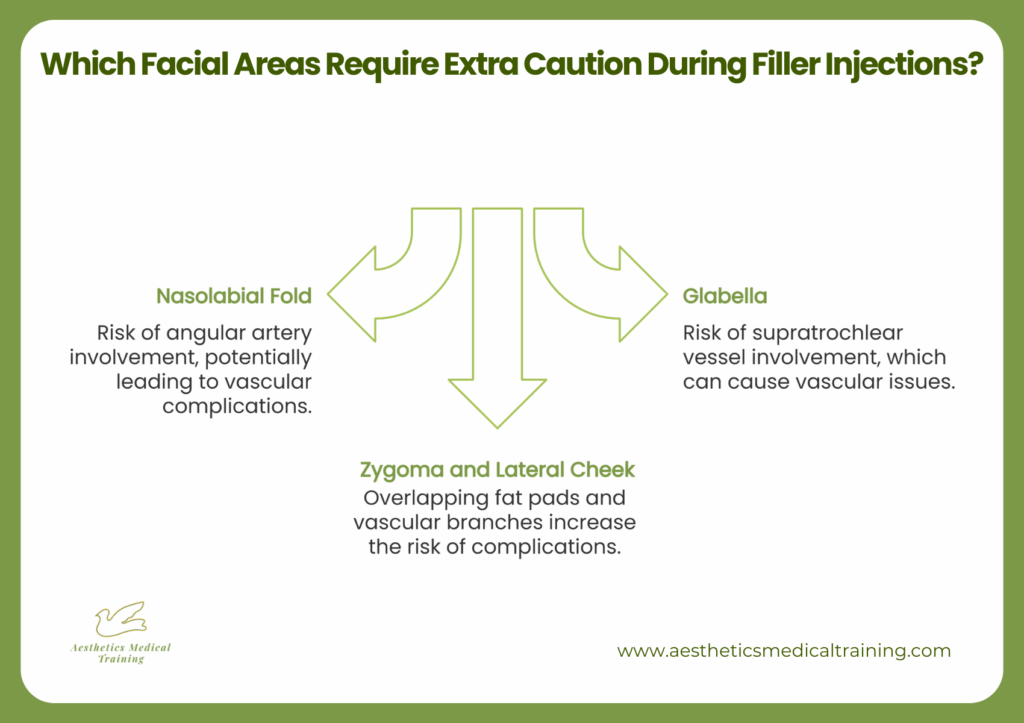
- The nasolabial fold (due to the angular artery)
- The glabella (linked to the supratrochlear vessels)
- The zygoma and lateral cheek (where superficial and deep fat pads overlap with vascular branches)
Safe Injection Landmarks
To improve safety and outcomes, aesthetic clinicians rely on anatomical landmarks.
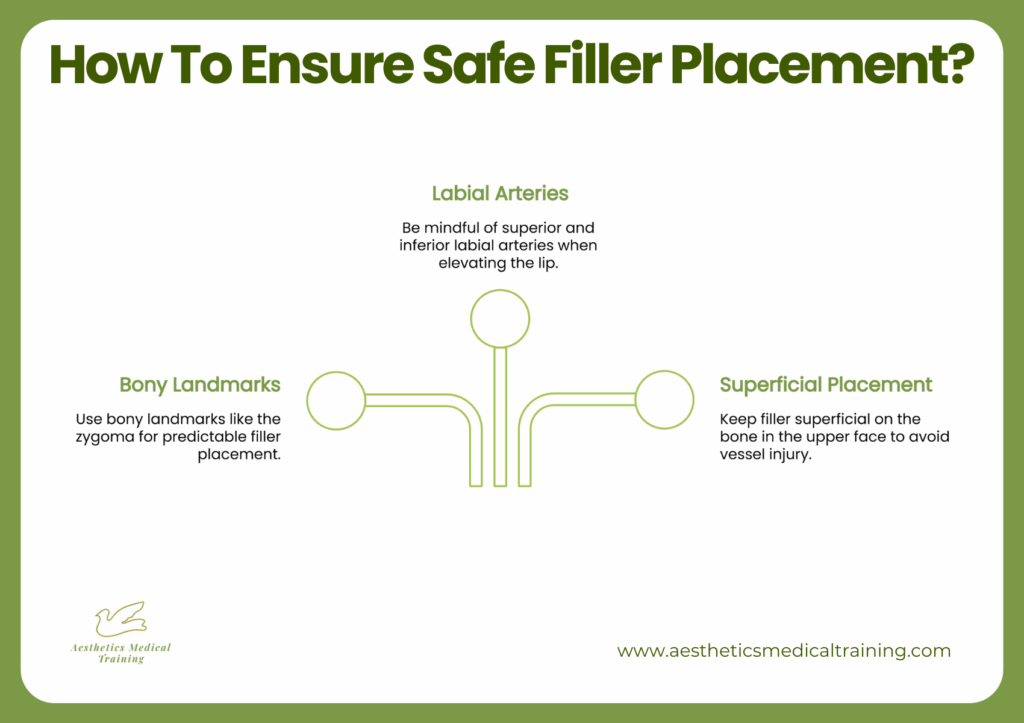
- Inject along bony landmarks such as the zygoma for predictable filler placement.
- When aiming to elevate the lip, stay mindful of the superior and inferior labial arteries.
- In the upper face, keep filler superficial on the bone to avoid injury to the supraorbital and supratrochlear vessels.
Recognizing these important facial structures ensures both beautiful results and better management of complications in modern medical aesthetic practice.
Can injectors avoid complications completely?
Complications can’t be eliminated, but good anatomical knowledge and proper technique reduce the risk.
Building Confidence with Training and Practice
No matter how many textbooks you read, nothing compares to hands-on training when it comes to mastering facial anatomy for injectables. In fact, research in medical education consistently shows that practical, simulation-based learning improves both skill retention and confidence. For aesthetic clinicians, this means translating anatomical theory into safe, predictable filler injection techniques.
Confidence as an injector comes from two key things:
- Guided practice under expert supervision
- Repetition that reinforces both knowledge and technique
Consistent practice helps clinicians:
- Develop a three-dimensional understanding of facial layers—from skin and superficial fat pads to deeper muscles and vasculature
- Recognize landmarks more quickly during treatment
- Refine needle and cannula skills to reduce the risk of complications
- Build muscle memory for safer angles, depths, and product placement
- Improve the ability to manage complications calmly and effectively
The bottom line? Theory gives you the “map,” but practice shows you how to navigate real-life faces with precision and artistry. The more you inject under expert guidance, the safer and more skilled you become.
Do all injectors need hands-on training?
Yes, practical training is essential for building confidence and refining safe techniques.
Take the Next Step with Aesthetics Medical Training
If you’re ready to elevate your career in aesthetic medicine, Aesthetics Medical Training (AMT) offers the perfect next step. Our mission is straightforward: to provide licensed medical professionals with expert-led, safety-focused education that combines science, artistry, and hands-on skills.
With AMT, you’ll gain:
- Expert guidance in Botox and dermal filler injection techniques
- Step-by-step training designed for beginners and advanced injectors
- In-depth anatomy education for safe, natural results
- Hands-on practice to build real confidence
- Certification that opens new doors in the growing field of medical aesthetics
Whether you’re learning filler foundations, refining technique, or mastering aftercare artistry, AMT equips you to deliver results patients love.
✨ Ready to grow your skills? Explore our courses today and take your place in the future of aesthetics. Get in touch for more information.